

Live Oak
Tree Description:
A large, stately tree, commonly to 50 feet tall with a short, stout trunk of 4 feet or more in diameter, dividing into several large, twisting limbs that form a low, dense crown that can spread more than 100 feet, the limbs often touching the ground in open-grown settings.
Range/Site Description:
Occurs on well-drained soils in the southern coastal plain, from Virginia through the Atlantic and Gulf states and into Texas, west to the Balcones Escarpment and south to Hidalgo county. Widely planted as a landscape tree in Texas.
Leaf:
Simple, alternate, evergreen, thick, and leathery; oval, oblong, or elliptical in shape, 2" to 4" long and 0.5" to 2" wide; smooth, glossy, and dark green above, pale and silvery white beneath. Leaves can sometimes be toothed, especially towards the tip.
Flower:
Borne in spring on the same tree, the male flowers on catkins up to 3" long, the female flowers on a peduncle 1" to 3" long in the leaf axils.
Fruit:
An acorn, requiring one year to mature, about 1" long and 0.5" in diameter, oblong, dark brown and shiny, set about one-half its length in a gray, downy cup that is borne on a long stem or peduncle.
Bark:
Dark brown, rough, and furrowed on trunk and large branches, developing very thick, interlacing ridges and deep furrows on older trees. Some specimens have thinner, paler, scaly bark.
Wood:
Very heavy, hard, strong and tough, light brown with nearly white, thin sapwood; formerly used in shipbuilding and for wagon wheel hubs. Now primarily sold as a landscape tree in the nursery trade.
Similar Species:
Texas live oak (Quercus fusiformis) occurs north and west of the Balcones Escarpment in Central Texas and tends to be smaller and multi-trunked. Mexican blue oak (Q. oblongifolia) is a rare evergreen oak that occurs in West Texas.
Interesting Facts:
Live oaks were once prized for their naturally curved limbs and trunk, used by shipbuilders in the 18th Century to fashion the ribs and planking of tall sailing ships, such as "Old Ironsides." Refitting that ship in the 1980's included specialty pieces cut from live oaks in Texas that had been killed by the oak wilt fungus.

Red Oak
Tree Description:
A large forest tree to 100 feet tall and a trunk sometimes exceeding 3 feet in diameter, with an open, rounded crown of glossy foliage. A common, but highly variable species.
Range/Site Description:
In East Texas, west to the Brazos River, growing on a wide range of sites from dry hills to more moist slopes and bottomlands.
Leaf:
Simple, alternate, highly variable, but usually 5" to 10" long and up to 5" wide, with 3 to 5 bristle-tipped lobes, the central lobe often longest; lobes typically come off the midrib at acute angles (not perpendicular) and are often limited to the upper half of the leaf. Leaf color is glossy and gray-green on top, paler gray below, with soft pubescence.
Flower:
Male and female flowers borne separately in spring on the same tree; male catkins 3" to 5" long, yellowish-green, female flowers inconspicuous and borne on a short, downy stalk.
Fruit:
An acorn, requiring two years to mature, 0.5" long, rounded or hemispheric, set about one-third its length in a thin, saucer-shaped cup that tapers to a short stalk.
Bark:
Light gray on younger trees, turning dark gray, rough, and not deeply furrowed on older trunks.
Wood:
Heavy, hard, strong, coarse-grained, and valuable for lumber. The bark is rich in tannin. The tree is also desirable as a shade tree and is available in the nursery trade.
Similar Species:
Black oak (Quercus velutina) has a larger acorn with a "fringed" cup.
Interesting Facts:
Some botanists split this species into three or four varieties because it has such variable leaf shapes on different sites.

Bur Oak
Tree Description:
A large tree of the prairies reaching a height of 80 feet or more and a trunk diameter of 5 feet, with a short body and heavy branches that form an open, spreading crown of dark green foliage.
Range/Site Description:
Occurs on limestone soils in Central Texas as far west as Tom Green county, often on rich bottomlands along streams or hillsides and banks along spring-fed rivers. Also planted widely as a landscape tree throughout Texas.
Leaf:
Simple, alternate, 6" to 12" long and 3" to 6" wide, with 5 to 9 highly variable lobes that lack bristle-tips; lobes are divided by at least one pair of very deep sinuses, and the upper one-third of the leaf typically has a roughly-toothed or weakly-lobed margin.
Flower:
Separate male and female flowers appear in spring on the same tree. Male flowers borne on a yellowish catkin 4" to 6" long; inconspicuous female flowers reddish in color.
Fruit:
An acorn, requiring a single season to mature, 1" to 2" long, ovoid, set deeply in a mossy-fringed cup that gives the species its common name.
Bark:
Twigs and branches are thick, developing conspicuous corky ridges after the second year; bark is light gray, rough and breaks into small, narrow flakes on young trees, then develops very thick bark with deep fissures and narrow plates.
Wood:
Heavy, hard, strong, tough and durable; used for lumber, crossties, and fuelwood.
Similar Species:
White oak (Quercus alba) is found in East Texas and has smaller acorns without a fringed cup.
Interesting Facts:
Acorns are prized by wildlife and can be used to make a coarse flour.

Monterrey Oak
Tree Description:
A medium-sized oak to 40 feet tall and a trunk to 2 feet in diameter, with a broad, rounded crown.
Range/Site Description:
Naturally occurring only in one known U.S. population, near the Devil's River in Val Verde county, but more common in Mexico. Now planted widely as a landscape tree.
Leaf:
imple, alternate, 2" to 5" long, highly variable, but often with several shallow lobes or teeth towards the tip. Leaves are thick, leathery, and semi-evergreen, with distinct raised veins on the yellowish underside. New leaves in spring are peach-colored and in colder climates the leaves are late-deciduous and turn yellow-brown.
Flower:
Male and female flowers borne in spring on the same tree, the male flowers on catkins up to 4" long, the female flowers less conspicuous.
Fruit:
An acorn, maturing in one year, up to 1" long and enclosed one-half by the acorn cup.
Bark:
Dark to light gray, developing scales and flaky plates, then shallow fissures on older trunks.
Wood:
Primarily used as a landscape tree in the nursery trade, and often sold as 'Monterrey oak.'
Similar Species:
Netleaf oak (Quercus rugosa) has similar venation on the undersides of leaves, but has obovate leaves and is restricted to high elevations in West Texas.
Interesting Facts:
Only recently discovered in the U.S. (1992) as a native tree species, but widely available in commercial nurseries.

Chinkapin Oak
Tree Description:
A medium or large tree reaching a height of 70 feet and a trunk to 3 feet in diameter, with a rounded crown of glossy, green foliage. It is also planted widely as a shade tree suitable for limestone soils.
Range/Site Description:
Occurs from northeast Texas to Central Texas and south to the Guadalupe River, and also in the mountains of West Texas, growing on mostly limestone soils, especially at the base of bluffs and along stream courses.
Leaf:
Simple, alternate, oval to elliptical or oblong in shape, 4" to 6" long and 1.5" to 2" wide, leaf edge rather sharply toothed but without bristle-tips, teeth slightly recurved.
Flower:
Separate male and female flowers appear in spring on the same tree. Male flowers borne on a yellowish catkin 3" to 4" long; the female flowers are less conspicuous and reddish.
Fruit:
An acorn, requiring just one season to mature, 0.5" to 1.25" long, light to dark brown when ripe, enclosed by one-half its length byt the bowl-shaped cup. Acorn is edible if roasted.
Bark:
Light gray, breaking into short, narrow flakes on the main trunk and limbs, deeply furrowed on older trunks.
Wood:
Heavy, hard, strong, durable, and taking an excellent polish; used for barrels, fencing, crossties, fuel, and occasionally for furniture.
Similar Species:
Swamp chestnut oak (Quercus michauxii) occurs in southeast Texas and has larger leaves with rounded teeth.
Interesting Facts:
Chinkapin oak is named because of the resemblance of the leaves to the Allegheny chinquapin (Castanea pumila), a relative of American chestnut (C. dentata).
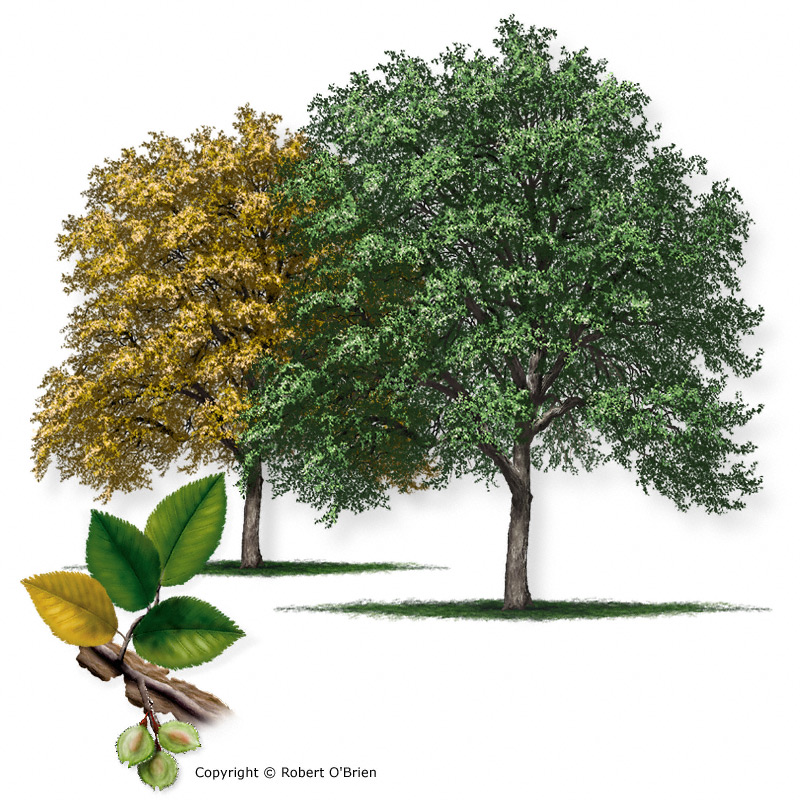
Cedar Elm
Tree Description:
A large tree to 75 feet tall with a tall, straight trunk 2 to 3 feet in diameter and stiff branches that form a narrow, oblong crown.
Range/Site Description:
The most common elm tree in Texas, distributed widely in East, South, and Central Texas. Most often found near streams, in solid stands on flatwoods near rivers, or on dry limestone hills. Also widely planted as a landscape tree.
Leaf:
Alternate, simple, 1" to 2.5" long and 0.75" to 1" wide, oval to elliptical in shape, finely-toothed or sometimes double-toothed along the margin, and blunt at the tip. The upper surface is dark green, shiny, and rough, while the lower surface and petiole are pubescent. Twigs sometimes have thin, corky "wings" and the leaves can turn gold to orange-red in the fall.
Flower:
Appear in late summer or autumn as hairy, short-stalked clusters in the leaf axils.
Fruit:
An oval "samara," 0.25" to 0.5" long, the seed centered in the middle of the wing, deeply notched at the tip, and hairy all over, especially along the margin. Seeds are borne in the fall, which distinguishes this species from the other native elms.
Bark:
Light brown to gray, with flattened ridges that break into thin, loose, flaky scales.
Wood:
Reddish-brown, brittle, with a thick layer of light-colored sapwood. The wood is sometimes used to manufacture wheel hubs, furniture, and fencing. Commonly sold in the nursery trade as a landscape tree.
Similar Species:
Winged elm (Ulmus alata) has larger leaves and seeds that mature in spring; varieties of Chinese elm (U. parvifolia) have similar leaves, but the bark is distinctly orange and flaky.
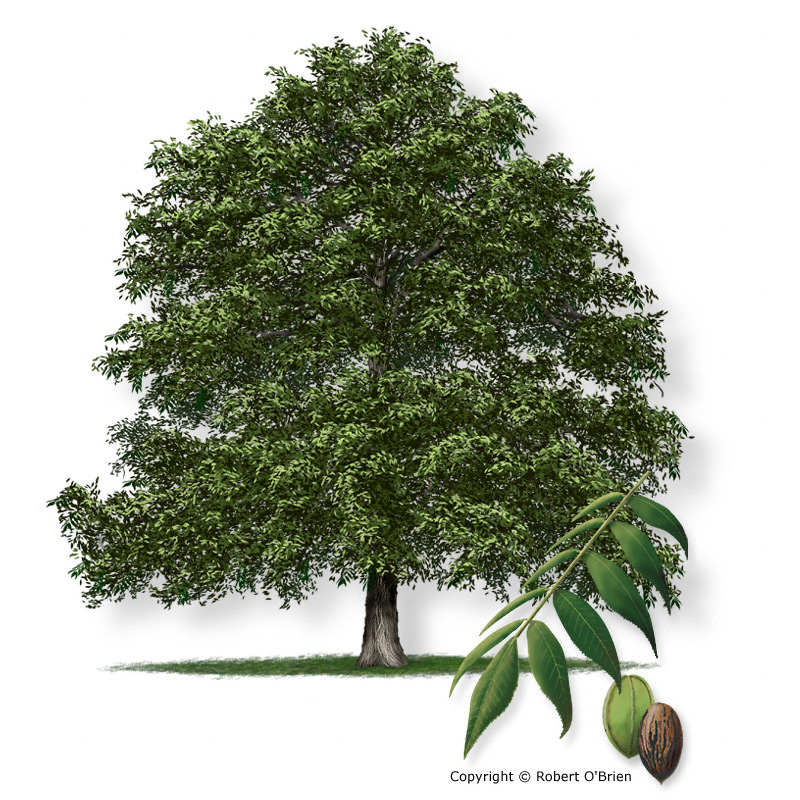
Pecan
Tree Description:
A large tree to 120 feet tall and a trunk to 4 feet in diameter, with a broad, spreading crown when grown in the open. In wooded settings, it grows tall and slender, with ascending branches and a tight, flat-topped crown.
Range/Site Description:
Occurs in rich, fertile bottomlands across most of the state, from the East Texas pineywoods throughout Central Texas and west to the Concho River valley. Planted widely as a landscape tree and in orchards for nut production.
Leaf:
Alternate, once-compound, 12" to 20" long, with 11 to 17 leaflets, each 4" to 8" long and up to 2" wide, lanceolate in shape, often falcate or inequilateral, finely-toothed and long-pointed; largest leaflets are typically towards the end of the leaf. Branches, twigs, and leaves lack thorns or prickles.
Flower:
Male and female flowers appear in early spring, separately on the same tree; male catkins are 3" to 6" long, female flowers in short spikes at the tips of the branches.
Fruit:
A large, cylindrical or oval nut, 1" to 2" long and up to 1" in diameter, enclosed in a thin husk which opens along grooved seams when the fruit ripens in the fall. The nuts vary considerably in size and thickness of shell and are rich in protein, oil, and minerals.
Bark:
Gray-brown and smooth at first, later breaking into thin scales that flake as the bark grows older, developing a rough texture of narrow, flat ridges and shallow fissures on older trunks.
Wood:
Heavy, hard, brittle, not strong, used for flooring and cooking wood, especially for barbeques. The tree is cultivated widely for its nuts, and many varieties have been developed and are sold in large quantities.
Similar Species:
Water hickory (Carya aquatica) grows on very wet sites in East Texas and has narrow leaves and a small, flattened nut; black walnut (Juglans nigra) has more leaflets, leaves that are pubescent underneath, and a large, round fruit without seams on the husk.
Interesting Facts:
Pecan is the state tree of Texas!
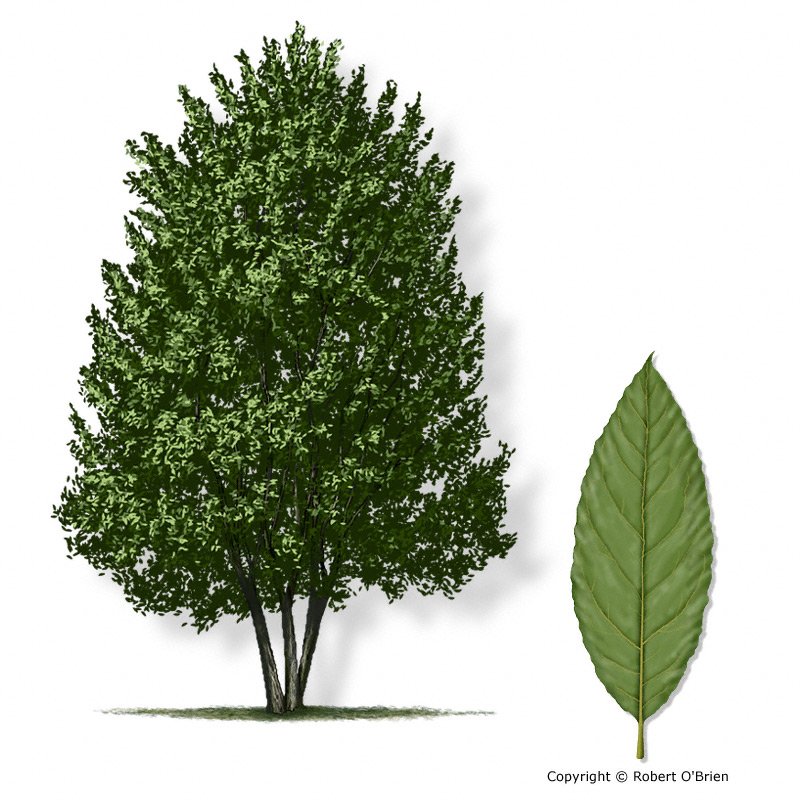
Sweetbay Magnolia
Tree Description:
A tree 60 to 80 feet tall, usually smaller, and a trunk to 2 feet in diameter, with an oval crown of glossy, green foliage.
Range/Site Description:
Found in swamps and on rich, moist soils in dense forests in southeast Texas.
Leaf:
Simple, alternate, 4" to 6" long and 1" to 2.5" wide, elliptical or oblong, pale green and glossy above, silky-white beneath, semi-evergreen or evergreen.
Flower:
Opening during several weeks of spring and early summer, with showy flowers 2" to 3" across, each with 9 to 12 creamy white petals on slender smooth stems.
Fruit:
An aggregate or "cone," oval or cylindrical, 2" long, dark red or brown, containing scarlet seeds which are oval, flattened, and less than 0.5" long.
Bark:
Light gray to brown, aromatic if bruised; the branchlets are silky-white.
Wood:
Soft, creamy white to reddish, at one time used for furniture, boxes, woodenware, and Venetian blinds.
Similar Species:
Redbay (Persea borbonia) has narrower, aromatic leaves, inconspicuous flowers and small, round dark fruits; southern magnolia (Magnolia grandiflora) has larger flowers and leaves with rusty-brown hairs underneath.
Interesting Facts:
At one time the flowers were used to manufacture certain perfumes.
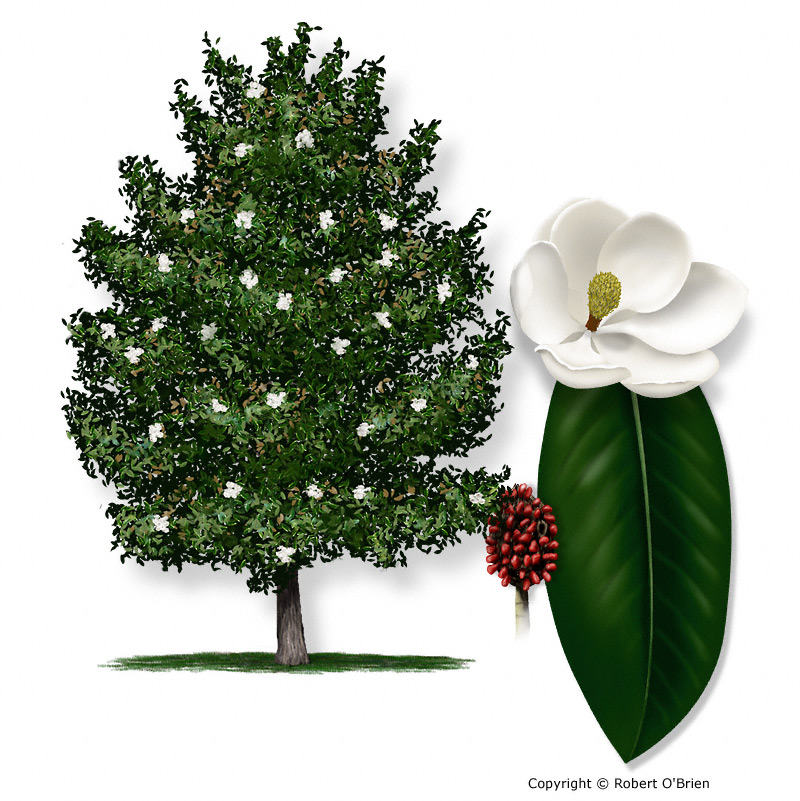
Southern Magnolia
Tree Description:
A large forest or landscape tree, reaching heights of 90 feet or more and a trunk to 4 feet in diameter, with a dense, pyramidal or oval crown, the spreading branches often reaching the ground in open settings.
Range/Site Description:
Occurs on rich, moist, well-drained soils on streambanks or the borders of river swamps in southeast Texas. It has been widely cultivated as an ornamental tree outside its native range.
Leaf:
Simple, alternate, 6" to 8" long and 2" to 3" wide, elliptical or oval in shape, thick, leathery, dark green and glossy above, rusty and pubescent beneath, with prominent midribs. They remain on the tree for about two years.
Flower:
Large, showy, and fragrant, 6" to 8" across, cup-shaped, with pure white petals surrounding a splash of bright purple in the center, borne in spring and summer.
Fruit:
A rounded or oval aggregation of seeds, shaped like a cone, 3" to 4" long, containing many seeds. The fruits open in the fall and display the bright red seeds dangling on slender threads.
Bark:
Gray-brown, smooth at first and developing scales on larger branches and trunks.
Wood:
Moderately heavy, hard, and cream-colored; was used chiefly for furniture, Venetian blinds, and fuelwood, but is now highly valued as a landscape specimen.
Similar Species:
Southern Magnolia (Magnolia virginiana) has smaller, semi-evergreen leaves and flowers.
Interesting Facts:
Magnolias are an ancient genus, one of the oldest flowering plants, extending back approximately 130 million years.
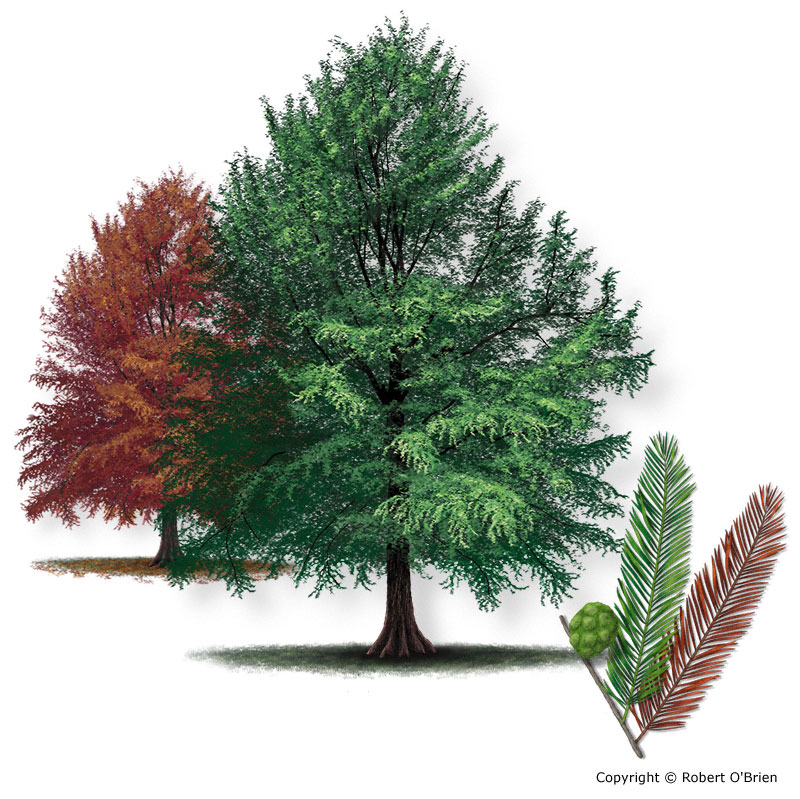
Baldcypress
Tree Description:
One of the few deciduous conifers of North America, baldcypress is a large tree to over 100 feet tall and a straight trunk to 8 feet in diameter, with numerous ascending branches. Young trees display a narrow, conical outline, but old trees have a swollen, fluted base, a slowly tapering trunk, and a broad, open, flat top. In swamps, they develop distinctive woody growths from the root system called "knees."
Range/Site Description:
In East Texas, west to the Nueces River, and Central Texas, growing on riverbanks, bottomlands, and in swamps that are flooded for prolonged periods. Planted widely as a landscape tree.
Leaf:
The slender, light green leaves are flattened, about 0.5" to 0.75" long, very narrow, and arranged in a feather-like fashion along two sides of small branchlets 2" to 4" long, which are deciduous in the autumn with the leaves still attached. Flowering branchlets sometimes have awl-like leaves. Fall color is a striking copper or reddish-brown.
Flower:
Male conelets or "flowers" are arranged along a thread-like catkin 3" to 4" long, appearing in the spring; female conelets are small and inconspicuous.
Fruit:
A rounded cone about 1" in diameter, wrinkled into thick, rough scales, greenish or with a waxy coating.
Bark:
Silvery to cinnamon-red, with papery scales on branches but developing large,r flat-topped ridges and numerous longitudinal fissures with age.
Wood:
Light, soft, easily worked, with a light-colored sapwood and dark brown heartwood. It is particularly durable when exposed to soil and water, so cypress is in demand for exterior trim, boat and ship building, shingles, posts, poles, etc. Also in demand as a landscape tree.
Similar Species:
Montezuma baldcypress (Taxodium mucronatum) has longer male flower catkins in the spring.
Interesting Facts:
Central Texas populations of this species do not produce the woody "knees," the function of which is not known. They may serve to help balance the tree on soft, muddy soils.
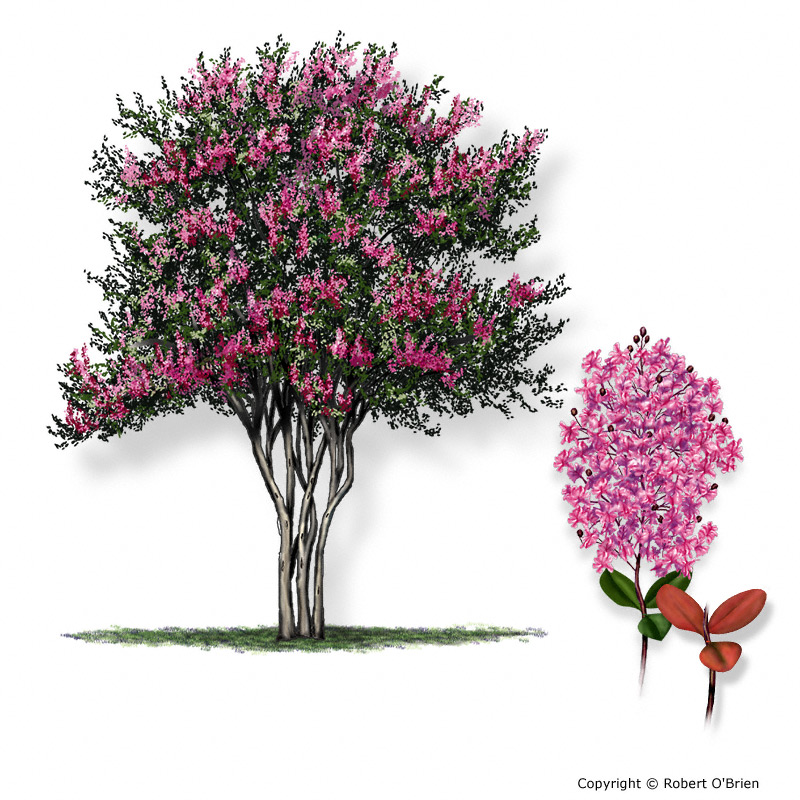
Crapemyrtle
Tree Description:
Perhaps the most common small landscape tree or large shrub planted in Texas, the crapemyrtle is usually multi-trunked with smooth, muscular limbs, grows to 20 feet tall and 15 feet wide, with mature trunks ranging from 4" to 12" in diameter.
Range/Site Description:
Native to China and Korea, it performs well as a landscape tree across most of Texas. It tolerates a wide range of site conditions, including drought and slightly alkaline soils.
Leaf:
Simple, alternate, 1.5" to 3" long, oval to oblong, thin, blunt-tipped, without teeth along leaf edge. Some cultivars turn red or orange in the fall.
Flower:
Showy spikes of white, pink, red, or purple flowers appear throughout the summer, each made up of petals that resemble crepe paper. Not fragrant.
Fruit:
An upright spike of round 0.5" diameter green fruits develops in late summer, drying to brown spherical capsules that open to release the winged seeds up to 0.25" long.
Bark:
Smooth, muscular, in irregular patches ranging from tan to chocolate-colored, peeling during the growing season into long, thin strips that fall away to reveal new bark beneath.
Wood:
Hard, dense, light-colored; no commercial uses. Major economic value is in the nursery trade; many cultivars are available, with selections from the National Arboretum being the most pest-resistant.
Similar Species:
Queen's crapemyrtle (Lagerstroemia speciosa) and Japanese crapemyrtle (L. fauriei) are similar, but have opposite leaves.
Interesting Facts:
A common - but incorrect - pruning practice of removing the entire top of the tree each winter is called "crape murder."
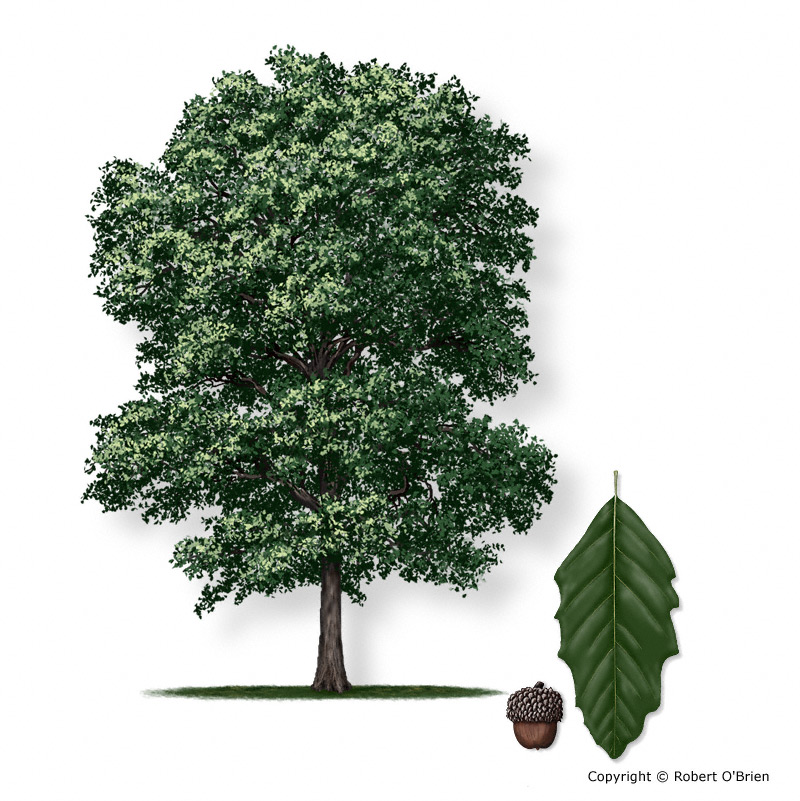
Mexican White Oak
Tree Description:
A medium-sized oak to 40 feet tall and a trunk to 2 feet in diameter, with a broad, rounded crown.
Range/Site Description:
Naturally occurring only in one known U.S. population, near the Devil's River in Val Verde County, but more common in Mexico. Now widely planted as a landscape tree.
Leaf:
Simple, alternate, 2" to 5" long, highly variable, but often with several shallow lobes or teeth towards the tip. Leaves are thick, leathery, and semi-evergreen, with distinct raised veins on the yellowish underside. New leaves in spring are peach-colored, and in colder climates, the leaves are late-deciduous and turn yellow-brown.
Flower:
Male and female flowers are borne in spring on the same tree, the male flowers on catkins up to 4" long, the female flowers are less conspicuous.
Fruit:
An acorn, maturing in one year, up to 1" long and enclosed one-half by the acorn cup.
Bark:
Dark to light gray, developing scales and flaky plates, then shallow fissures on older trunks.
Wood:
Primarily used as a landscape tree in the nursery trade, and often sold as 'Monterrey oak.'
Similar Species:
Netleaf oak (Quercus rugosa) has similar venation on the undersides of leaves, but has obovate leaves and is restricted to high elevations in West Texas.
Interesting Facts:
Only recently discovered in the U.S. (1992) as a native tree species, but widely available in commercial nurseries.
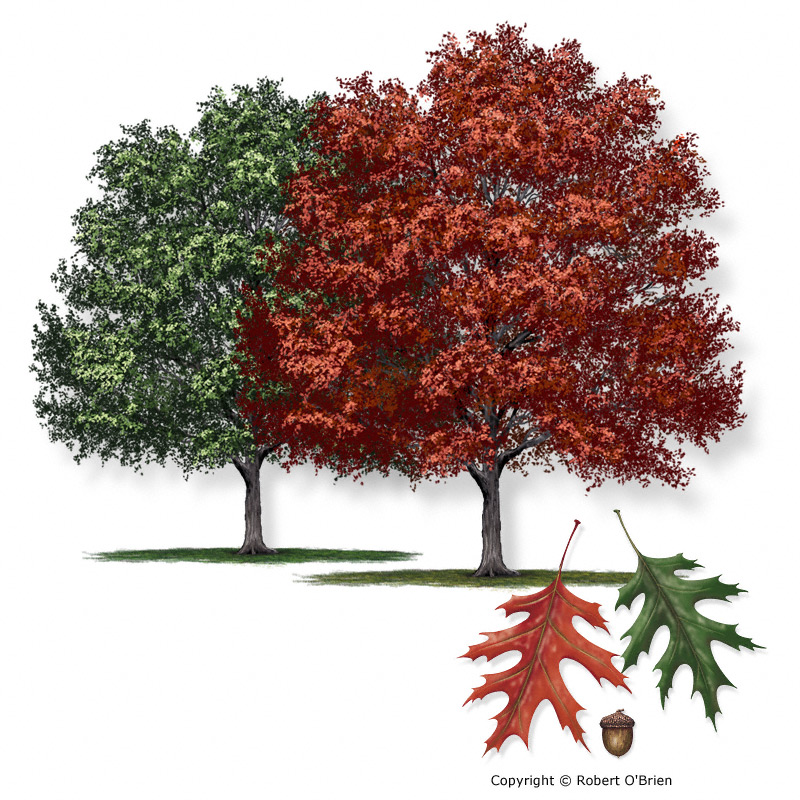
Shumard Oak
Tree Description:
A large forest tree reaching heights of 100 feet or more and a trunk to 3 feet in diameter, with a wide-spreading, symmetrical crown. It often occurs as a single tree or in small groups in forest stands, and is an excellent landscape tree.
Range/Site Description:
Occurs in East Texas on well-drained alluvial soils and on fertile slopes, west to the Balcones Escarpment near Austin and San Antonio, and then northeast to Dallas and the Red River.
Leaf:
Simple, alternate, 6" to 8" long and 4" to 5" wide, usually with 7 to 9 bristle-tipped lobes (rarely 5), the widest lobes on the upper half of the leaf, with one or more pairs of deep, rounded sinuses between the lobes. Leaves are glossy, dark green on top, light green and smooth beneath, except for small tufts of pubescence in the axils of the veins.
Flower:
Male and female flowers are borne in spring on the same tree, the male flowers on catkins 6" to 7" long, the female flowers solitary or paired in the leaf axils.
Fruit:
An acorn, requiring two years to mature, 0.75" to 1.25" long and 0.5" to 1" in diameter, set only at the base in a shallow, saucer-like cup.
Bark:
Dark gray, smooth and tight at first, but developing flat, interlacing ridges and rough fissures with age. Old trees can have deep fissures between the smooth ridges.
Wood:
Heavy, hard, strong, close-grained, and light reddish-brown in color, and commercially important for lumber, furniture, flooring, interior trim, and veneer.
Similar Species:
Texas oak (Quercus buckleyi) is a closely related Central Texas counterpart to Shumard oak, but typically has smaller leaves and acorns; southern red oak (Q. falcata) has more variable leaves with pubescent undersides and small acorns; black oak (Q. velutina) has larger leaves with more regular lobing and a fringed acorn cup.
Interesting Facts:
This species was named for Benjamin Franklin Shumard (1820-1869), a former state geologist of Texas who organized the first comprehensive geological survey of Texas.